CLInt – Book Review – March 2026
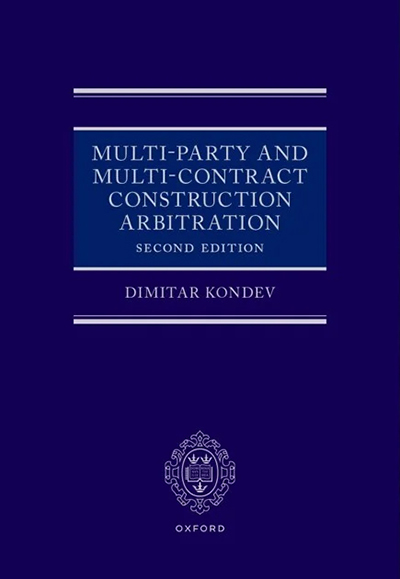
Multi-Party and Multi-Contract Construction Arbitration (2nd edn)
Author: Dimitar Kondev
Published by: Oxford University Press, 2025
ISBN: 978-0-19-286765-0
496 pages, £175
Publication date: 23 September 2025
Reviewed by Thayananthan Baskaran and Ng Faye Xiang
Multi-Party and Multi-Contract Construction Arbitration provides a comprehensive examination of the legal, procedural and contractual challenges arising from multi-party disputes in the construction sector. The book combines theoretical analysis with practical insight, and progresses from foundational concepts and terminology to a detailed examination of multi-party arbitration. It further undertakes a comparative analysis of institutional arbitration rules and national arbitration laws, and examines contractual solutions adopted in leading international standard forms of construction contracts. The later chapters propose jurisdictional, contractual and institutional reforms aimed at addressing structural limitations in existing frameworks.
This review focuses on Chapter 2, ‘Multi-Party Arbitration in General’, which offers an overview of the concept, procedures, advantages and practical difficulties of multi-party arbitration. Chapter 2 begins with a clear discussion of terminology, defining multi-party arbitration and distinguishing it from multi-contract arbitration. The author highlights that the terms multi-party arbitration and multi-contract arbitration are sometimes used interchangeably. While the terms may overlap, they are conceptually different. The chapter then outlines procedures relating to multi-party arbitration, including single requests against multiple parties, joinder, intervention and consolidation. These explanations are concise yet informative, providing readers with a practical understanding of how multi-party proceedings are initiated and managed. The requirements as to the application of each procedure are discussed in Chapters 4–6.
A central focus of Chapter 2 is the discussion of the advantages of multi-party arbitration, notably the avoidance of inconsistent findings; reduction in time and costs; and the minimisation of factual errors. These advantages are clearly articulated and grounded in procedural efficiency, demonstrating why multi-party arbitration is increasingly regarded as a desirable mechanism in complex construction disputes involving multiple participants and interrelated claims.
Chapter 2 also examines the principal obstacles to multi-party arbitration, with a particular emphasis on the consensual nature of arbitration; the traditional perception of arbitration as a bipartite process; and concerns relating to confidentiality, the setting aside of proceedings and the recognition and enforcement of arbitral awards. It further addresses practical difficulties inherent in multi-party arbitration. The author also considers scenarios where multi-party arbitration is not possible, offering a realistic perspective.
One of the key strengths of Chapter 2 is its balance between conceptual clarity and practical insight. The analysis is accessible and well structured, and is grounded in references to institutional arbitration rules, relevant national arbitration laws and broader scholarly literature, reflecting the author’s dual perspective as both a scholar and practitioner. By addressing both the advantages and challenges of multi-party arbitration, the chapter enables readers to assess its feasibility and implications in construction disputes in a measured and informed manner.
Overall, Chapter 2 makes a significant contribution by providing a foundational analysis of multi-party construction arbitration, and highlighting both its benefits and practical challenges. It establishes the analytical framework for the book’s subsequent examination of construction-specific applications, institutional rules and contractual solutions, and responds to the increasing complexity of modern construction disputes. For practitioners involved in multi-party or multi-contract disputes, as well as academics seeking a clear conceptual overview, this book constitutes a concise, authoritative and highly useful resource.