Gaza is being subjected to the ‘worst-case scenario of famine’
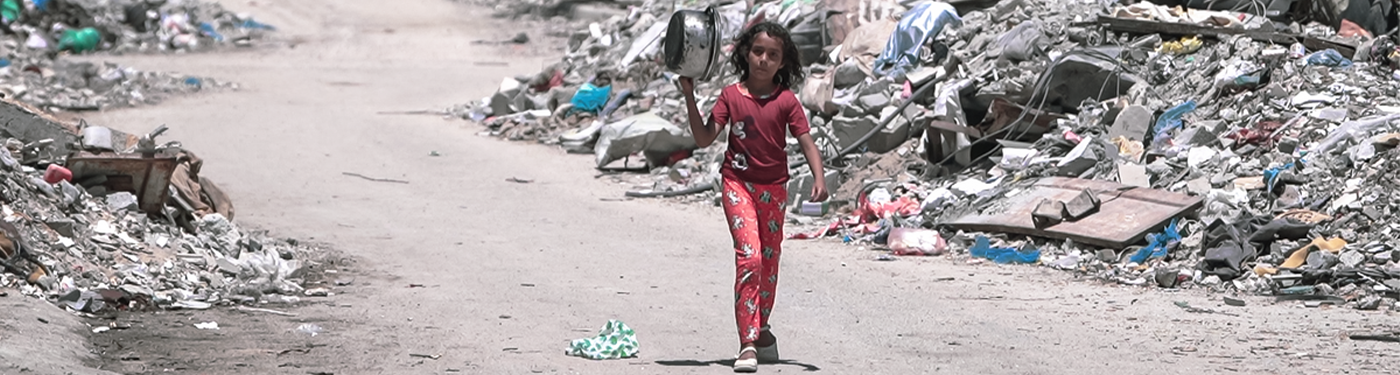
Girl walking to get food in Gaza. Jaber Jehad Badwan/Wikimedia Commons.
In August, an Integrated Food Security Phase Classification analysis confirmed famine in Gaza’s largest city and surrounding areas. The World Health Organization recorded 63 malnutrition-related deaths in Gaza in July alone. It blames the ‘deliberate blocking and delay of large-scale food, health, and humanitarian aid’.
A consensus among UN agencies and aid organisations about famine in Gaza has emerged. Human Rights Watch, Amnesty International and Doctors Without Borders have all condemned what they allege is Israel’s intentional use of starvation as a weapon of war, describing it as a direct cause of Gaza’s humanitarian crisis. The IBA’s Human Rights Institute (IBAHRI) has condemned the ‘deliberate starvation’ of Gaza’s population as breaching international law.
Catriona Murdoch, an international criminal barrister, says that Israel, by wielding aid as a bargaining chip, is flouting core humanitarian duties to provide aid unconditionally. The strategy has exacerbated the pre-existing humanitarian crisis and has contributed to the staggeringly quick impact of food insecurity, she says. ‘The conduct of Israel in routinely blocking [aid] for extended periods or making the conditions of delivery so dangerous or logistically impossible, would fall within the set of rules which prohibits this type of conduct,’ she says, referring to international humanitarian law (IHL). ‘Starvation is the process of deprivation that occurs when actors impede the capacity of civilians to access the means of sustaining life.’
Israeli officials reject these accusations and deny any deliberate famine policy. They defend aid limits by pointing to security risks to Israeli citizens and blame Hamas for siphoning off supplies to its fighters. Israel says it only bars ‘dual-use’ items – which could serve military ends – from aid.
Commentators say that some statements and actions by Israeli officials indicate criminal intent. In January, for example, Israeli media outlet Haaretz reported that members of a Knesset committee had advocated the destruction of northern Gaza’s food, water and power supplies as a military tactic against Hamas. Despite Israel’s 2005 withdrawal from Gaza to the Strip’s outside borders, experts say Israel remains the occupying power, controlling the territory’s borders and resources. Under international law, this obliges it to provide civilians with basic necessities – a duty, critics say, it hasn’t upheld.
I think that a prosecution case alleging starvation as a war crime is a strong one
Stephen Rapp
Former US Ambassador-at-large for War Crimes Issues
‘In the case of Israel, given the repeated and public statements made indicating a specific intent to seal off areas [and] restrict food and water, coupled with the dehumanising language and strong rhetoric of starvation tactics, it would be difficult to run a defence based on denial that civilians were not the intended target of this siege and starve campaign,’ says Murdoch.
Analysts argue that Israel’s 11-week complete blockade on food deliveries to Gaza, which lasted from March to May, could form the backbone of a powerful war crimes prosecution, with starvation as a central charge. Stephen Rapp, IBAHRI Council Member and former US Ambassador-at-large for War Crimes Issues, says that intent – a critical element in such cases – may be legally inferred from the predictable consequences of sealing off the enclave while destroying its lifelines. Israel controlled all access points after its military operations rendered the Rafah Border Crossing inoperable and crippled local food production.
‘Even if it was reasonable to presume that the civilian population could control Hamas’ decisions, it is well settled that a party cannot commit IHL violations in order to force another party to comply with its obligations,’ Rapp says.
‘Starvation of civilians as a method of warfare as a war crime contrary to Article 8(2)(b)(xxv) of the [Rome] Statute’ was one of the charges laid against Israeli Prime Minister Benjamin Netanyahu alongside Yoav Gallant, the former Minister of Defense of Israel, by the International Criminal Court (ICC) when it issued arrest warrants for both in November 2024. Israel denies the charges.
‘I think that a prosecution case alleging starvation as a war crime is a strong one,’ Rapp says. ‘The full blockade and tighter restrictions of 2025 will make cases stronger, and harder to defend against, at the ICC and in national systems exercising universal jurisdiction.’
The IBAHRI, while condemning the attacks by Hamas against Israel that took place on 7 October 2023, dismisses Israel’s aid-diversion claims as unsubstantiated, citing an internal USAID (US Agency for International Development) study. As such, the claims ‘in no way justify bypassing international humanitarian norms,’ the IBAHRI says. Officials from bodies such as the UN World Food Programme have denied Israeli claims of large-scale, organised theft by Hamas but have said some aid was stolen ‘by criminal gangs, under the watch of Israeli forces’.
In January 2024, and again in May of the same year, the International Court of Justice demanded that Israel allow full, unhindered humanitarian access to Gaza, including by ensuring aid delivery. Despite this, Israel has failed to comply.
Alex de Waal, Executive Director of the World Peace Foundation at Tufts University, highlights the duration during which aid has been prevented as grounds for accusations of criminal conduct. ‘A military commander cannot starve a population by accident,’ he says. ‘It takes weeks to starve. During this time, information is available about the outcome. In Gaza, authoritative warnings have been repeatedly issued [eg] by the UN. Failing to act on these warnings should be taken as evidence for criminal intent.’
Groups convene for Special Tribunal for the Crime of Aggression event
On 29 September, leading legal and diplomatic experts met in The Hague to discuss the establishment and operationalisation of the Special Tribunal for the Crime of Aggression in Ukraine. The event was hosted by the IBA, the Embassy of Ukraine to the Kingdom of the Netherlands and the Kingdom of the Netherlands. The event was also livestreamed.
The event addressed the legal and institutional architecture of the Special Tribunal, its relationship to the ICC and other existing accountability mechanisms. It also examined victim participation frameworks and the role of states in supporting the Tribunal's mandate.
The need for a Special Tribunal for the Crime of Aggression was established following Russia’s full-scale invasion of Ukraine in February 2022. In April 2024, a Council of Europe (CoE) Committee of Ministers authorised the drafting of an agreement for the Tribunal, and on 25 June 2025 President Zelenskyy and the CoE Secretary General formally signed the agreement.
The high-level speakers included: Andriy Kostin, Ambassador Extraordinary and Plenipotentiary of Ukraine to the Kingdom of the Netherlands and former Prosecutor General of Ukraine; Anton Korynevych, Director of the Department of International Law of the Ministry of Foreign Affairs of Ukraine; Claudio Visco, IBA President-Elect; Mark Ellis, IBA Executive Director; Myroslava Krasnoborova, Liaison Prosecutor for Ukraine to Eurojust; Veronika Plotnikova, Head of the Coordination Center for the Support of Victims and Witnesses of War and Other International Crimes, Prosecutor General's Office of Ukraine; and Nout van Woudenberg, Cluster Coordinator ‘Accountability for Ukraine’, Multilateral Affairs and Human Rights Department, Ministry of Foreign Affairs of the Kingdom of the Netherlands.
This is the fourth in a series of events hosted by the IBA to support the Special Tribunal’s development. Events were held earlier in Washington, DC (27 June), Geneva (4 July) and Kyiv (17 September) engaging legal experts, diplomats and civil society in dialogue about the imperative of accountability for the crime of aggression.
IBAHRI highlights gender apartheid regime in Afghanistan after four years under Taliban
Four years have passed since the Taliban regained control of Afghanistan, with the milestone reached on 15 August 2025. As Afghan women and girls face systematic rights violations and a worsening humanitarian crisis, the IBAHRI underscores the continued need for international condemnation and concrete accountability measures.
Since taking back control of the country, the de facto authorities have issued a litany of decrees which have severely curtailed women’s and girls’ rights, including the rights to freedom of movement; participation in public affairs; access to education, work and healthcare; and the right to justice.
IBAHRI Director Baroness Helena Kennedy LT KC commented: ‘Developing multiple accountability mechanisms and codifying gender apartheid into international law is essential to hold perpetrators of this systematic repression responsible. In 2021, the IBAHRI evacuated over 100 Afghan female judges and lawyers. We continue to emphasise the urgent need for the international community to provide safe refuge to Afghans fleeing repression.’
Furthermore, the IBAHRI is gravely concerned by the mass expulsion of over 1.9 million Afghan refugees from Iran and Pakistan since January 2025. These actions violate international obligations under the 1951 Refugee Convention and endanger vulnerable populations. According to UN Women, women and girls represent just under one-third of returnees from Iran and about half of all returnees from Pakistan.
Roundtable: Syria’s transition nine months on
In December 2024, a coalition of armed opposition groups overthrew the government of Bashar al-Assad, marking the end of over 50 years of the Assad family’s rule in Syria. The country then entered a pivotal phase of transition, with an interim five-year constitution in place and a new government led by interim President, Ahmed al-Sharaa. At the time of writing, elections are expected to take place in early October.
The IBAHRI, the University of Lancaster’s Sectarianism, Proxies and De-sectarianisation (SEPAD) project and the UK Foreign Policy Centre hosted a roundtable on the situation in the Syrian Arab Republic on 9 September at the UK Parliament’s House of Lords. IBAHRI Director and Member of the House of Lords, Helena Kennedy, chaired the discussion, which also featured parliamentarians, legal and policy experts, Syrian civil society representatives and academics.
The roundtable aimed to take stock of where things now stand in Syria with a focus on the development of mechanisms for international justice and accountability.
Read Global Insight cover feature 'Syria after Assad: a fragile new beginning' here.
Ukraine: Young legal minds engage with global justice leaders at IBA co-sponsored Criminal Justice Summer School
This summer, promising young legal minds were brought together in Kyiv, Ukraine for an intensive and inspiring programme at the 2025 Criminal Justice Summer School (the Summer School). Organising by JustGroup and co-sponsored by the IBA, the initiative offered 25 Ukraine-based top law students and early-careers practitioners a rare opportunity to engage directly with leading voices in law, ethics and reform.
Set against the backdrop of Ukraine’s evolving justice landscape, the programme blended academic depth with practical training to prepare participants for the complex legal challenges ahead; bridge the gap between students and criminal justice institutions by offering practical, value-driven legal education; and develop a new generation of legal professionals who are bold, ethical and committed to justice and human rights.
The five-day Summer School was held between 18–22 August 2025. The programme combined academic rigor with hands-on exercises, offering students exposure to real-world challenges in the Ukrainian and international justice systems.
A standout moment for the Summer School students was day three, held at the Supreme Court of Ukraine, where participants examined the complex legal issues of international crimes, war crimes and trials in absentia. Students met with Andriy Leshchenko, Deputy Prosecutor General; Anton Korynevych, Ambassador-at-Large of the Ministry of Foreign Affairs of Ukraine; and Mykola Mazur, Judge of the Grand Chamber of the Supreme Court of Ukraine. Mark Ellis, IBA Executive Director, participated by video link from London.
Ellis commented: ‘Even amid the extraordinary and unprecedented challenges facing Ukraine as a result of Russia’s brutal actions, the fairness of national legal proceedings must not be compromised. Programmes such as the Criminal Justice Summer School are essential to sustaining a legal culture grounded in integrity, human rights and accountability.’
Criminal proceedings against Istanbul Bar Association raise concern
Following the announcement of criminal and civil proceedings against the executive board of the Istanbul Bar Association, the IBAHRI submitted a joint amicus curiae brief to the Istanbul 26th Heavy Penal Court on 5 September 2025 alongside 11 other legal and human rights organisations. In the brief, the IBAHRI warned that the legal proceedings are incompatible with Turkey’s international human rights obligations and represent a direct assault on the independence of the legal profession.
The legal action follows a public statement issued by the Bar on 21 December 2024 following the deaths of two Kurdish journalists, Nazım Daştan and Cihan Bilgin, allegedly killed in a drone strike in northern Syria.
The Bar’s statement called for international legal protections to be afforded for journalists in conflict zones and an effective investigation into the deaths. It also demanded the release of protestors and lawyers detained at a demonstration held in Istanbul that same day. In response, prosecutors in Turkey launched criminal proceedings against the Istanbul Bar Association’s leadership.
‘The Istanbul Bar’s statement was well within its statutory duties and its internationally protected role. To criminalise such a statement is both legally indefensible and politically alarming,’ said IBAHRI Director Helena Kennedy.
IBA condemns additional US sanctions against ICC officials

The IBA has condemned the imposition of additional sanctions against ICC judges and officials by the US administration in August 2025 as an attack against the global rule of law and the independence of judges and called on all ICC States Parties to take actions to protect the Court.
The US imposed sanctions against two ICC judges, Judge Nicolas Guillou and Judge Kimberly Prost, and against Deputy Prosecutor Nazhat Shameem Khan and Deputy Prosecutor Mame Mandiaye Niang. As a result of the sanctions, the designated persons will be banned from entering the US and their US assets will be blocked.
Judge Guillou was among the judges who approved the issuance of arrest warrants for Israeli Prime Minister Benjamin Netanyahu and former Defence Minister Yoav Gallant in November 2024.
Judge Prost was among the judges who authorised the opening of an ICC investigation in the situation in Afghanistan in March 2020.
The US has previously sanctioned four other judges who took part in those decisions in June 2025, and in February 2025 sanctioned the ICC Prosecutor Karim Khan.
CJEU ruling on ‘safe’ countries offers crucial legal protection to migrants

A recent judgment from the Court of Justice of the European Union (CJEU) on Italy’s plan to process asylum applications offshore has provided migrants with crucial legal protection.
The judgment, published in August, concerns the principle of ‘safe countries of origin’ and affects Italian Prime Minister Giorgia Meloni’s agreement with Albania, a non-EU country. Italy’s scheme is designed to repatriate migrants who have been picked up in the Mediterranean. ‘The CJEU judgment is the natural consequence of this latest attempt by a national government to outsource asylum processing and decide for itself – without the right to challenge – what is a “safe” country,’ says Alex Stojicevic, an officer of the IBA Immigration and Nationality Law Committee.
The case concerned two asylum seekers from Bangladesh, a country that Italy deemed ‘safe’ in the context of its immigration rules. Pursuant to the Italy-Albania agreement, the two individuals were being held in a detention centre in the latter country designed for those with limited chances of a successful asylum application and were to be repatriated through a fast-track procedure.
There were three strands to the Court’s conclusions. The first was to endorse the original orders of the Italian immigration judges who found that the migrants had to be sent back to Italy from Albania on the grounds that a country can only be deemed ‘safe’ by an EU Member State if it offers 'adequate protection for its entire population'.
However, new rules are coming into effect that will supersede this finding. The EU’s Pact On Migration and Asylum, which was adopted in summer 2024 and becomes applicable from June 2026, changes the notion of what’s considered a ‘safe’ country of origin. Under the Pact, a country of origin may be designated safe even if, for an individual applicant, there could be a threat posed to that person based on, for example, their religion or sexuality, or because they’re from a certain region.
The judgment is the natural consequence of an attempt by a national government to outsource asylum processing and decide for itself – without the right to challenge – what is a “safe” country
Alex Stojicevic
Officer, IBA Immigration and Nationality Law Committee
It’s the second and third elements of the CJEU’s judgment that appear set to provide legal protection for migrants, and in part explain why 16 EU Member States intervened in the case. The CJEU found that schemes such as that put in place by Italy will only be lawful to the extent that the process, and the designation by a Member State as to what is and isn’t a ‘safe’ country, can be properly and effectively challenged in the courts. Further, the sources of information, the data and evidence relied upon to reach any decision around the safety of a country must be accessible.
The immediate consequence for Italy is that the Albanian detention centre will be, for now, under-used. Ultimately, the new EU Pact will substantially increase the parameters of what might be considered a safe country for repatriating irregular migrants and thus provides Member States with greater room for manoeuvre to do so.
However, the CJEU judgment ensures these parameters will probably be subject to considerable challenge in the courts. ‘The buried treasure in the [CJEU judgment] is the effectiveness of a challenge, and access to documents,’ says Steve Peers, a professor of EU and human rights law at Royal Holloway, University of London. ‘With the new EU Pact, it might be easier to say a country is safe but it will be easier to challenge this in individual cases.’
Peers believes those challenges will probably turn into a debate about, for instance, the client’s religion or sexuality and a country’s treatment of this category. This is exactly what the 16 Member States that intervened in the CJEU case were afraid of, he believes. ‘As they see it, their internal procedures will be clogged up with legal challenges,’ says Peers.
According to Meloni, the CJEU is ‘claiming jurisdiction that does not belong to it […] The European Court of Justice has decided to delegate to any national judge the decision […] on the part of migration policy relating to the repatriation and expulsion of illegal immigrants.’
In the UK in August, a local council was successful in its application to the High Court to have a hotel in Epping, near to London, banned from housing irregular immigrants. The ruling was however overturned at the Court of Appeal. What followed was criticism, including by a senior lawmaker, of the judges involved in this and other immigration cases. The suggestion was that their backgrounds and personal views were influencing their rulings.
A major concern is that this rhetoric against the judiciary undermines the rule of law. ‘Over time, this position erodes the view that the courts are legitimate,’ says Stojicevic, who’s also Managing Partner at MKS Immigration Lawyers in Vancouver.
Despite the CJEU judgment, the combination of the new EU Pact coming into effect and a European Parliament that’s more hardline in its attitude to immigration means the EU appears set to take an increasingly restrictive approach on the issue. ‘We could see the Pact develop such that whole countries are declared safe and the rules being re-written to make it difficult to challenge that,’ says Stojicevic. The EU might even consider deportations, which ‘are a feature of the Canadian and Australian systems and, as we well know, are looked on favourably in the US right now,’ he adds.
Header image credit: 'Angels unawares' sculpture, by Timothy Schmalz. The sculpture sits in St Peter's Square, Vatican City, and depicts a group of migrants and refugees on a boat wearing clothes from diverse cultures and historical moments. Real_Life/AdobeStock.com