Paradox of two wrongs: examining the unmentioned implications of the Supreme Court decision in Providence v Hexagon

Brendan Low
Middle Temple, London
|
When does a cured default stop being a ‘wrong’ – and should it still count towards a contractor’s right to terminate for repeat late payment under the Joint Contract Tribunal (JCT)’s standard form contractual clauses? The JCT has a suite of contractual clauses used in construction projects that allocate design, time, payment and risk. The article argues that the recent Supreme Court decision of Providence Building Services Ltd v Hexagon Housing Association Ltd, that concerns the interpretation of clauses 8.9.3 and 8.9.4 jointly, has given rise to a paradox concerning repeated wrongs. This article seeks to analyse the recently published judgment, while simultaneously unpacking the paradox for an international audience. |
Introduction[1]
If someone has done a wrong to you but corrected that wrong within X amount of time in which you said, ‘if you do not correct the wrong within X amount of time our friendship is over’, is that wrong still technically a wrong? Perhaps in the context of a friendship spat one might be inclined to say yes to the question, but in the context of construction law things get a little trickier.
In the recent Supreme Court judgment of Providence v Hexagon, an analogous question arose in the context of ‘a short point of contractual interpretation’ on the 2016 edition of the JCT Design and Build Contract, which affects the most recently published 2024 version whose wording of the termination clause is identical to that of the 2016 version.[2] The key question was whether a right to terminate under clause 8.9.3 must first have accrued before a contractor has any right to terminate under clause 8.9.4.
‘If a specified default or a specified suspension event continues for 28 days from the receipt of notice under clause 8.9.1 or 8.9.2, the Contractor may on, or within 21 days from, the expiry of that 28 day period by a further notice to the Employer terminate the Contractor’s employment under this Contract.’[3]
Clause 8.9.3
‘If the Contractor for any reason does not give the further notice referred to in clause 8.9.3, but (whether previously repeated or not): [...] the Employer repeats a specified default [...] then, upon or within 28 days after such repetition, the Contractor may by notice to the Employer terminate the Contractor’s employment under this Contract.’[4]
Clause 8.9.4
Clause 8.9.3 embodies what in practice is known as the right to cure principle. Under clause 8.9.3, a period of 28 days is provided to remedy any default in payment by the Employer. This period of 28 days is to be counted from the day on which the Contractor gives a notice to the Employer specifying the default of payment. A notice requirement is stipulated by clause 8.9.1 of the JCT[5] (and the parties’) contract, acting as a precondition for the Contractor to seek termination rights under clauses 8.9.3 and 8.9.4. Under clause 8.9.3, the word ‘continues’ is important, as it implies that the default must be ongoing and unremedied at the 28-day mark.
Meanwhile, clause 8.9.4 governs situations where the Contractor had the choice to serve a notice as per clause 8.9.1 and 8.9.3 but chooses not to. The phrase ‘for any reason’ qualifies such situations and is one which the High Court and Court of Appeal disagreed on in terms of interpretation and implication.[6] The issue subsisted in the Supreme Court: namely whether ‘for any reason’ was ‘broad enough to catch a case where the reason why the further notice may not be given is that there is no accrued right to give it’.[7]
Turning to the facts of the case, the dispute concerns two payment defaults that occurred in a contract for construction works in Purley, valued at approximately £7.2m. The contract was entered into in February 2019 between Providence Building Services (Contractor) and Hexagon Housing Association (Employer). The timeline of the two payment defaults is illustrated in Table 1.
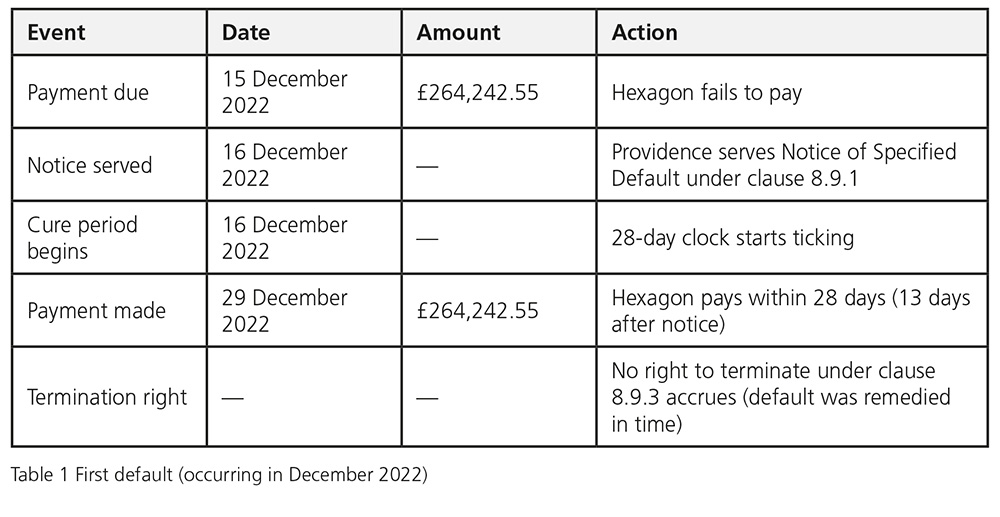
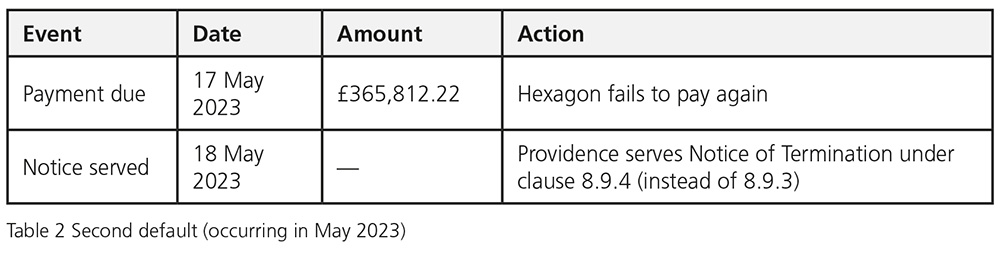
The first default illustrates Hexagon exercising its right to cure – the 28 days given to it under clause 8.9.3 – and nothing controversial occurs until the second default.
This time, however, Providence sought to immediately terminate the contract under clause 8.9.4, arguing that this second default amounted to a repeated and continued specified default[8] since Hexagon paid late in December and was now late again in May. This was done without notice and without needing to wait another 28 days, since Providence argued that clause 8.9.4 provides a basis for contractual termination independent of clauses 8.9.1 and 8.9.3. In response, Hexagon maintained that the first default does not count as a ‘repeat’ default for the purposes of clause 8.9.4 since it had been cured.
The saga stretched across several levels of the court. The High Court sided with Hexagon, the Employer, on the basis that the natural and ordinary meaning of clauses 8.9.3 and 8.9.4 in context was that a clause 8.9.3 notice could have been provided but was not, for whatever reason.[9] The High Court was not persuaded by arguments in the theme of ‘harsh and uncommercial’ implications – for example, that the Employer could make a payment 27 days late but still within the 28 day time window and so avoid the Contractor being able to terminate.[10]
The Court of Appeal, however, sided with Providence, the Contractor. It found that a right to terminate under clause 8.9.3 need not have accrued as a prerequisite for triggering termination rights under clause 8.9.4. The ‘for any reason’ clause upon textual interpretation was broad enough to encompass a situation where no right under clause 8.9.3 had accrued. The conclusion was that the second default amounted to a repeated and continued specified default.[11] However, the Court of Appeal was similarly not persuaded by arguments in the theme of commercial commonsense, such as the Employer’s argument that there is a ‘battery’ of other remedies for a contractor to counter cash flow difficulties created by an employer making late payments.
The Supreme Court, in its first published judgment of 2026, returned to side with the Employer, however, through an approach to interpretation that is more dynamic of both clauses than that of the High Court. While the High Court interpreted clause 8.9.3 in a ‘straightforward’ way before turning to clause 8.9.4, interpreting both clauses as two subsequent and isolated steps,[12] the Supreme Court read clause 8.9.4 as ‘parasitic’ on clause 8.9.3.[13] The Supreme Court put this in another way: ‘it is only if the Employer has failed to cure any earlier specified default within 28 days that the Contractor can terminate for a repetition of the specified default’.[14]
Interestingly, Lord Burrows, with whom the other judges agreed, hypothesised several reasons for the Contractor not exercising its earlier right to terminate. In Lord Burrows’ words:
‘It may have been, for example, that the late payment was made by the Employer, albeit after the 28 days allowed for cure, and the Contractor exercised the choice to accept that payment and to continue with the contract; or the Contractor may have inadvertently failed to exercise its right to give the further notice of termination. The precise reason why the Contractor failed to give the further notice to terminate is not significant because the words “for any reason does not give the further notice [to terminate]” clearly cover all possible reasons.’[15]
Although Lord Burrows was careful at the end not to dilute the ‘for any reason’ broad wording, the paragraph itself implicitly presses the significance of a contractor providing a notice that corresponds to the ‘specified default’. In other words, this approach of interpretation that makes clause 8.9.4 dependant on clause 8.9.3 would mean that every particular employer default must be responded to a contractor’s own particular notice, heightening the duty on contractors.
The courts, although exercising pure interpretation, would inevitably create commercial implications that benefit one group over another in the same industry, here the Employer over the contractor. In the author’s view, the method of reasoning at each level veils a deeper analytical framework. The courts express a leaning towards a certain commercial reality without falling foul of the orthodox canons of English contract law interpretation that focus on the words used by the parties in the contract and express a caution towards placing weight on commercial sense.[16] The Supreme Court’s dynamic approach to interpretation may have further explored implications for further standard form contracts, both in the UK and, on the basis of the prominence of English law, outside (if the UK Supreme Court’s dynamic interpretation influences the reasoning of other courts – for example, in Commonwealth jurisdictions such as Malaysia, Singapore or Hong Kong).
The remainder of this article will be dedicated towards these unexplored implications, beginning with what a ‘wrong’ is in light of how the Supreme Court resolved this paradox.
Paradox of wrongs and canons of interpretation
The Supreme Court has now ruled conclusively that an interpretation which allows the contractor to walk out the door after two breaches, in this sense of ‘repeated’, would result in an ‘extreme outcome’.[17] Lord Burrows explained what this could entail if taken to the extreme:
‘It would mean that any breach by late payment (provided a specified notice of default were given by the Contractor), if repeated by any subsequent late payment, would entitle the Contractor to terminate the contract. For example, if the Employer made two late payments, each being made one day late, the Contractor, on this interpretation, would be entitled to serve a notice terminating the contract (provided a specified default notice had been served in respect of the first late payment). That might be thought to provide a sledgehammer to crack a nut.’[18]
A sledgehammer being used to crack a nut does connote an overly disproportionate response on the part of the contractor. Yet, although the result is concluded, it cannot be denied that this case left a philosophical question lingering: is a corrected wrong still a wrong? Returning to the facts, it sounds right to say that the ‘wrong’ existed at a point in time, in the 13 days in which Hexagon had not corrected its first default. However, Hexagon was acting within the 28-day time-limit it was given. In other words, there was no ‘wrong’ in this second sense of failing to abide by an obligation.
Since this obligation is only ‘activated’ by the issuance of a notice under clause 8.9.1 and its subject matter contained in clause 8.9.3, it could be said that this is a new obligation that exists separately from the first default. Could it then be said that there were two separate wrongs? On this interpretation, the first wrong remains alive regardless of any measures to correct it and regardless of the success or failure of those measures. Alternatively, could it be said that the new obligation created by clauses 8.9.1 and 8.9.3 replaces the first wrong, as that is the ‘logically sensible’ way to interpret clause 8.9.3, as otherwise why have a clause governing the curing of a defect at all?
The Supreme Court sidestepped such philosophical arguments, putting forward what can be regarded now as a principled approach to the interpretation of standard forms. The Supreme Court revived the approach used by the High Court in first instance comparing the words used in clauses 8.9.3 and 8.9.4 with the words used in clauses 8.4.2 and 8.4.3 of the JCT. The inclusion of the words ‘as a result of the ending of any specified default’ in the clause 8.4.2 and 8.4.3 dynamic, which were absent in the clause 8.9.3. and 8.9.4 dynamic, was interpreted by Lord Burrows as ‘there need be no previously accrued right to terminate’.[19] Lord Burrows also took this opportunity to note that Stuart-Smith LJ’s reasoning in the Court of Appeal that looked at the words of clause 8.9.4 in isolation was mistaken.[20] The movement away from looking at words in isolation erodes the foundation of philosophical arguments like the paradox of two wrongs. The contextual comparisons internal to the JCT standard form bore more significance since it is ‘the carefully considered product of the work of experienced construction professionals advised by expert lawyers’.[21] To clients, this suggests that any future disputes surrounding the interpretation of standard form contracts should begin by looking at structurally similar clauses in the standard form.
Obligation and right to cure
The facts of Providence present clause 9.8.3 as an obligation to cure, implied by the ticking-down clock before the 28-day period to cure is breached. The principles of the common law, however, had suggested that a legal right to cure exists as well. This refers to a contractual provision that gives the party in breach the opportunity to remedy or correct that breach within a specified time frame before the other party can exercise the more drastic termination or damages claim.
The right to cure is often relied upon by the contractor. In Manor Co-Living Ltd v RY Construction Ltd,[22] the employer purported to terminate the contractor’s employment under clause 8.4.2 of the JCT Standard Building Contract 2016. The employer served a default notice giving 14 days to remedy, then denied the contractor access into the construction site. However, the notice was found to be invalid and thus the employer had terminated the contract before the cure period had expired.
In other jurisdictions, such as under New York law, the courts may imply a right to cure via notice before allowing termination, treating such a right as a natural incident of the contractual relationship.[23] This approach has been reinforced by ‘right to repair’ statutes enacted in numerous states – including California, Florida, Texas and Washington – which mandate that contractors be given notice and an opportunity to repair defective work before owners may terminate or pursue litigation.[24]
There are several rationales for the right to cure, including giving the contractor a chance to correct the problem before drastic action is taken, since the contractor may face cash flow issues and time is often the necessary solution to remedy the default. Meanwhile, termination could delay the project and increase cost, not just to the parties but to general economic efficiency which relies on these projects. In East Empire Construction Inc v Borough Construction Group LLC,[25] the Appellate Division held that right to cure provisions may only be bypassed in ‘very limited and rare circumstances’ – namely, where the other party expressly repudiates or abandons performance or where the breach is impossible to cure.
Arguably, the same policy considerations apply to employers. Thus, in theory there should be no difference since the right to cure should be mutually provided to maintain a close business relationship. Internationally used standard forms, such as FIDIC, recognise this. Structured parallelly, clause 6.2 of FIDIC Red Book 2017[26] provides that a contractor must first give 14 days’ notice stating its intention to terminate and identifying those grounds.[27] If the employer does not remedy the breach within 14 days, the contractor may then issue a notice of termination, which takes effect when received.[28]
Similarly, the employer must first issue a ‘notice to correct’ under clause 15.1, specifying the failure and a reasonable time within which the contractor must remedy it.[29] Only if the contractor fails to correct may the employer proceed under clause 15.2 to issue a notice of intention to terminate (14 days), followed by a notice of termination if the default persists.[30]
The Supreme Court decision, although settled entirely as a matter of contractual interpretation, could be viewed in light of the ubiquity of the right to cure. If it is accepted that the second default by Hexagon is its own separate wrong, should it not deserve its own cure period? Had the Court of Appeal decision been affirmed instead, the employer who was now ‘skating on thin ice’[31] would be assumed to have lost their right to cure through their own wrong. Would this be too much of an alignment of power in favour of contractors?
Moving forward: global industrial impact of the Supreme Court’s interpretation
Clients would most likely be attracted by the UK apex court’s approach to standard forms, with courts in Commonwealth jurisdiction at least potentially persuaded by the influential body. Providence has redirected attention to the fact that there are ‘two types of standard form contract’:
‘In A Schroeder Music Publishing Co Ltd v Macaulay (formerly Instone) [1974] 1 WLR 1308, Lord Diplock helpfully distinguished between two types of standard form contract. One type is a “take it or leave it” standard form used by a party with superior bargaining power. The other type is an industry-wide standard form that has been negotiated by representatives of contracting parties on both (or all) sides of a particular trade or industry. Lord Diplock gave as examples, bills of lading, charterparties and contracts of sale in the commodity markets. One can add the JCT standard form contract as a further example.’[32]
The paragraph ends by stating that in relation to such ‘industry-wide standard form[s] […] inequality of bargaining power is not a problem’ and, citing Lord Diplock in Macaulay, it is to facilitate the conduct of trade. Thus, returning to our discussion on the policy behind the right to cure, the court may be less persuaded by arguments that seek to rebalance the power between employer and contractor. However, it is not impossible to argue that the obligation and right to cure exist to facilitate the conduct of trade.
Not every widely used standard form has a repeated breach provision. It is noteworthy that among JCT, FIDIC, NEC and EJCDC, it is only FIDIC which contains provision for immediate termination without notice. Under FIDIC, every breach requires fresh notice and a fresh 14-day cure period. Each default under FIDIC is a separate event requiring its own procedural compliance; no cumulative ‘strikes’ system operates.[33]
Similarly, under the NEC, which gives an employer 13 weeks before the contractor has the right to terminate, every fresh and separate breach must be allowed to run that 13 weeks.[34]
The Supreme Court decision could thus be said to place the contractual interpretation in JCT in line with the international standard form. While the Court of Appeal’s reading of clause 8.9.4 would render it without a close comparator in other standard forms, and could perhaps from a marketing angle be attractive as a template clause, the Supreme Court ultimately tended towards balance of obligations between employer and contractor and, simultaneously, whether intended or not, harmonisation across standard forms.
[2] Ibid [1].
[3] JCT Design and Build Contract 2016, cl 8.9.3.
[4] Ibid cl 8.9.4.
[5] Ibid cl 8.9.1.
[6] Providence Building Services Ltd v Hexagon Housing Association Ltd [2024] EWCA Civ 962 [16], [28] [34].
[7] Providence Building Services Ltd v Hexagon Housing Association Ltd [2026] UKSC 1 [20]
[8] Ibid.
[9] Providence Building Services Ltd v Hexagon Housing Association Ltd [2023] EWHC 2965 (TCC) [16].
[10] Ibid [23].
[11] Providence Building Services Ltd v Hexagon Housing Association Ltd [2024] EWCA Civ 962 [31].
[12] Providence Building Services Ltd v Hexagon Housing Association Ltd [2023] EWHC 2965 (TCC) [16] [18].
[13] Providence Building Services Ltd v Hexagon Housing Association Ltd [2026] UKSC 1 [32].
[14] Ibid.
[15] Ibid.
[16] Arnold v Britton [2015] UKSC 36.
[17] Providence Building Services Ltd v Hexagon Housing Association Ltd [2026] UKSC 1 [32].
[18] Ibid.
[19] Ibid [37].
[20] Ibid [36].
[21] Ibid [37].
[22] [2022] EWHC 279 (TCC).
[23] Adams LeClair LLP, ‘Notice of Default and Opportunity to Cure: Considerations and Limitations’ (17 May 2023) https://adamsleclair.law/blog/notice-of-default-and-opportunity-to-cure-considerations-and-limitations-to-examine-when-a-contract-party-is-in-breach accessed 28 November 2025; see also East Empire Construction Inc v Borough Construction Group LLC (2021) 200 AD 3d 1, 156 NYS 3d 148 (NY App Div, 1st Dept).
[24] See, eg, Cal Civ Code sections 895–945.5 (California Right to Repair Act); Fla Stat section 558.004 (Florida Construction Defect Statute); Tex Prop Code sections 27.001–27.007 (Texas Residential Construction Liability Act); Wash Rev Code section 64.50.020 (Washington Construction Defect Actions).
[25] East Empire Construction Inc v Borough Construction Group LLC (2021) 200 AD 3d 1, 156 NYS 3d 148 (NY App Div, 1st Dept).
[26] FIDIC, Conditions of Contract for Construction (2nd edn, 2017).
[27] Ibid cl 16.2.2.
[28] Ibid.
[29] Ibid cl 15.1.
[30] Ibid cl 15.2.
[31] Providence Building Services Ltd v Hexagon Housing Association Ltd [2024] EWCA Civ 962 [41] [42].
[32] Providence Building Services Ltd v Hexagon Housing Association Ltd [2026] UKSC 1 [25].
[33] FIDIC, Conditions of Contract for Construction for Building and Engineering Works Designed by the Employer (2nd edn, 2017) cls 15.2.1–15.2.2 ‘If the Contractor fails to remedy the matter described in the notice within 14 days of receiving the notice, the Employer may by giving a second notice to the Contractor immediately terminate the Contract; for subparas (f)–(h) the first notice may itself immediately terminate.’
[34] NEC4 Engineering and Construction Contract (2017) (UK/International).
|
Brendan Low is a graduate of the University of Cambridge (UK), Barrister-at-Law (Middle Temple) and is currently an LLM candidate at Peking University (Beijing, China). Any views and errors are the author’s own. Brendan can be contacted at bsll2@cantab.ac.uk. |