Prolongation costs – an issue with causation

Thierry Linares
FTI Consulting, Paris
Construction contract disputes often involve a decision on delay responsibility and the costs that ensue, usually claimed as ‘prolongation costs’ by the contractor. These costs are, however, scrutinised closely by counsel and arbitrators alike to assess whether they represent a material prejudice that may require (or not) to be compensated. This involves a review that can be quite complex, and for which the test for validity requires more details and questioning than usually put forward in a very ‘simple’ way by contractors. This may often be misleading – that is, by skipping or omitting details that would impact their assessment, amounting to a global cost claim. The underlying issue is always causation, as the costs and records attached need to demonstrate an adequate causal link with the delay generating them. This article explains the different tests that should be performed to ensure the prolongation costs ultimately awarded come as close as possible to the actual prejudice incurred and which shall be compensated, as per the contractual and legal considerations. |
Introduction
Counsel and arbitrators often have a challenging time resolving construction disputes due to the technicalities involved with delay analyses and quantum assessments. Parties in dispute present claims and expert evidence, often making use of differing concepts, methodologies and analysis. They may present asymmetric supporting evidence and inherently dissenting conclusions.
This is particularly the case when presenting prolongation claims, for which the quantum assessment relies on specific proof of the prejudice incurred, mixing both liability and causality in intricate ways.
In the worst-case scenario, these types of claims are brought forward as global cost claims, for simplicity presenting all loss incurred compared to the budget (or a simple proportionality of it) as caused by the underlying prolongation or disruption event.
However, this approach has proven to be very unconvincing, as well as departing from the actual prejudice for which a causal link can be established, preventing awards from following the same simplistic valuation principles.
The difficulty in reaching a legally acceptable decision is not in reperforming the analysis (which would be highly cost-ineffective or outright impossible) but in being able to question the assessment process, test the reasoning and opine on the supporting evidence. The causality between costs incurred and claimed events will be at the centre of this test of reasonability.
To reach a fair decision and navigate the scrutiny of prolongation costs effectively, a test dissecting the different elements of such a complex claim is drawn from experience, highlighting the usual factors hindering the analysis.
This article will solely address the quantum aspects; delay analysis and related disruption claims, driving the underlying entitlement, are not the subject of this article.
Standard practice
The standard practice and usual steps in presenting a prolongation cost claim is stated in the SCL[1] under four principles (clauses 20 and 22), as well as on the legal principle of ‘full reparation’.[2]
- ‘The objective is to put the Contractor in the same financial position it would have been if the Employer Risk Event had not occurred.’
- ‘It is up to the Contractor to demonstrate that it has actually suffered loss and/or expense before it becomes entitled to compensation.’
- ‘Compensation for prolongation resulting from Employer Risk Events will primarily comprise the Contractor’s extended use of time-related resources.’
- ‘The period to be evaluated is that in which the effect of the Employer Risk Event was felt.’
These principles, largely accepted and reiterated in a wealth of papers, written expert reports and publicised articles, are usually translated by contractors into a claim intended to showcase their indirect costs incurred as ‘time-related’, in proportion to the critical delays being claimed.
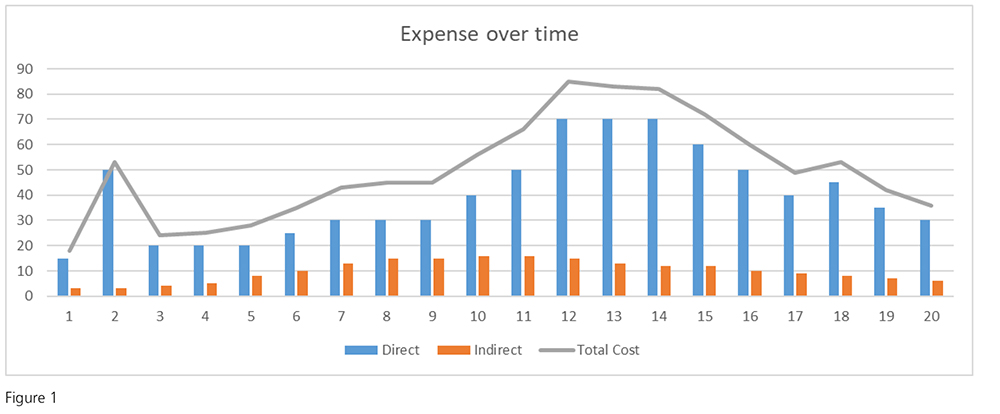
For example, in a base project which was planned for 20 months, the expense could be presented as follows. The focus for prolongation claims revolves around the extension of indirect costs (supervision and management, equipment, site facilities, securities and other running costs, etc).
Considering the project was hindered by a rework on site installations delaying the actual start of works, for four months from month six onwards, all other things being equal, the actual expense incurred may present the shape shown in Figure 2.
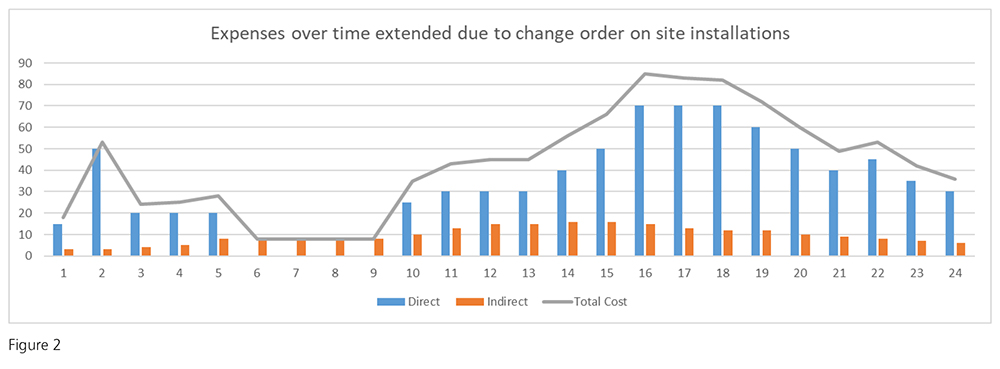
In this case, the contractor would look for recovery of its indirect costs for months six through to nine, as highlighted in Figure 2.
Usually, this is accomplished by calculating a daily average indirect costs rate (usually called a ‘burn rate’) and multiplying it for the duration of the extended period. Sometimes prolongation costs are even valued along the unit rates planned in the contract for additional or standby of resources, either by a defined unit rate or even by applying a prorata temporis calculation derived from the contract price.
Building on this concept, the contract includes a price breakdown that assigns a specific value to indirect costs or ‘preliminaries’. This creates a straightforward method: if preliminaries are $200 for 20 months, then valuing prolongation costs at $10 per month seems reasonable.
While very tempting, this simple calculation, which is usually presented as a fair assessment of prolongation costs, is only reasonable in very simple and straightforward situations, such as live construction projects where the parties have to agree upfront on the prospective costs resulting from an agreed extension, but in more complex cases this could be a significant departure from a reasonable compensation award.
Typically, prolongation costs are brought forward as a claim for compensation […] In some legal cases, prejudice can be considered a scope variation
Principal tests of an assessment
Additional tests are necessary to ensure the compensation sought is really remedying the prejudice incurred.
To ensure that the causal link between the delay events and the costs incurred is well established, one must refine the criteria for evaluation and put through several tests, as explained below.
Questioning the principle
Is the prejudice assessed based on actual costs effectively incurred?
It is worth mentioning that the prejudice to be assessed is, first, dependant on the contractual and legal framework in which it is claimed.
Typically, prolongation costs are brought forward as a claim for compensation and would be assessed as per the actual costs expended in relation to the prolongation as per the recommendations of the SCL protocol.
In some legal cases, prejudice can be considered a scope variation and thus valued using contract unit rates or standard standby/monthly rates.
The difference between contract rates and actual costs can be significant, inclusive of provisions, overheads, profit and so on. This is critically important as claimants must be aware of its implications, but also to ensure coherency in the resulting calculations – that is, between the approach based on accountancy documents showing actual indirect, as well as overheads costs spent, versus the rate-based calculations (presumably inclusive of these two mark-ups).
There are two key considerations that influence valuation, both of which are determined by actual costs and contractual rates:
Actual costs that would have been incurred in the regular course of business
In particular, if the contractor has mobilised resources in excess of the volume initially anticipated for its own reasons (‘thickening’), the period of prolongation would include actual costs on this thickened basis. The question is, should the claimed prolongation costs be limited to the initial volume of indirect costs or the thickened version? The question is in fact to be able to assess the delta between the actual costs incurred and the but-for scenario of the costs that it would have otherwise incurred, regardless of the delay event in question.
Any flexibility or risk allowance that would have been part of the scope of the contractor or included in the contract price
The indirect costs are typically reliant on an estimation, so the initial basis of costs represents the baseline against extensions of time and may not perfectly correspond to the actual prejudice. Allowances shall be taken into consideration (ie, exclude them from part of the compensation) and the question should be asked whether they shall be consumed first as pertaining to the project or whether they form part of the prejudice.
Is the burn rate a quick, accurate estimate?
The burn rate analysis needs to be assessed to accurately split windows (in line with delay analysis) for it to be sensible. This makes it possible to rely on a daily or even monthly rate but also ensures that this rate adapts to the costs of the period and is not a flat rate encompassing the entire project life cycle.
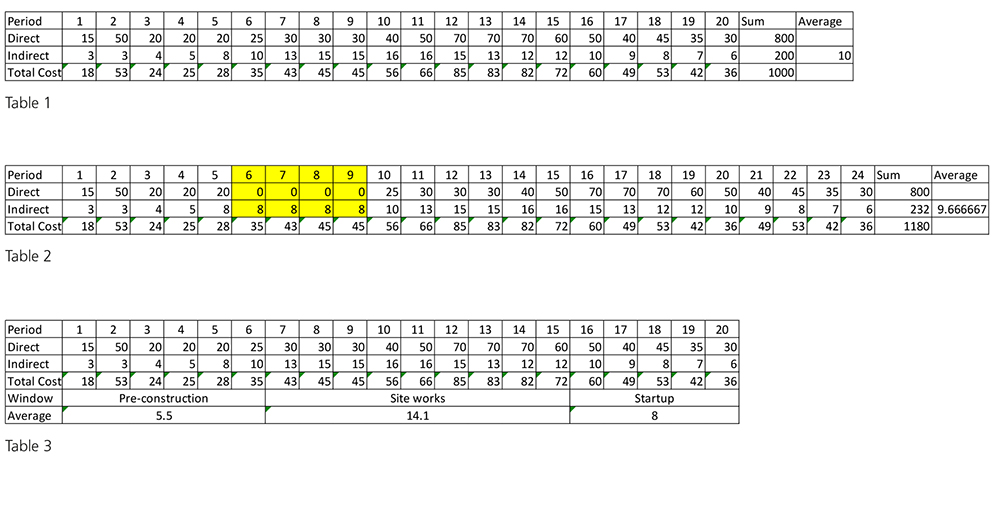
In the example in Table 1, indirect costs represent an average of $10 per month over the 20 months of the project. This is, however, not a linear expense, given that the mobilisation and expense of indirect costs is related to the project execution phase and usually would tend to be shaped as a bell curve.
The prolongation of months six through nine is, however, in a period during which indirect costs are comparatively lower, with $8 monthly spending, as highlighted in Table 2.
Should the quantification be based on a proportionality of contract preliminaries or a burn rate calculated at project level, it would therefore be overestimating the actual loss by about 25 per cent ($10 per month on planned budget, $9.7 on actual average instead of the actual $8 for the disrupted period).
A usual quick fix to this issue is to define windows in the analysis and to split the average burn rate calculation by window. This will result in a better relation between the phase (or state of progress) of the project and the level of spending in that phase.
For example, it could be envisaged that splitting the value of planned indirect costs into three windows for pre-construction, site works and commissioning/start-up may provide a slightly better granularity, with the delay falling towards the end of the pre-construction work (see Table 3).
This is unfortunately not the case and is the downfall of most assessments based on averages, in that the granularity needed for an average burn rate to be representative is so fine that the burn rate theory is not effective in obtaining a robust result. The facts of a case would frequently push one back to exclude the burn rate altogether and create windows only for the delayed periods – that is, fall back on an as-planned versus as-built analysis, singling out the actual costs of the disrupted period, which may be significantly different from the budgeted costs, in prior or later periods.
Are all indirect costs part of the actual prejudice?
The second issue with the burn rate, or even the singling out of disrupted periods, is that it fails to capture the actual effect of the delay but assumes that any expense is linked to that delay.
However, complex projects include multiple work fronts, both geographically (onshore and offshore), by discipline (civil, piping, etc) and by phase (engineering, construction, startup, etc).
A project’s daily burn rate includes indirect costs that support multiple work fronts. However, not all are impacted equally by delays on the critical path and their expenditures also fluctuate over time.
Therefore, the pool of indirect costs needs to be analysed more granularly: for example, on a bridge project, three project managers are mobilised, one for the piling works, one for slabs prefabrication and one for the connection to existing roads. Although, theoretically and for simplicity, all three are allocated for the 20-month duration of the project, a four-month delay in this scenario results in only one being extended, while the other two remain largely unaffected or not affected at all.
Without this factual and causal analysis, using a burn rate or simply looking at the indirect costs during the period of delay would lead to overestimating the prolongation of indirect costs by counting all three of them. The same would apply for a single person apportioning (potentially) their time on several work fronts.
These common issues mean that prejudice assessment requires the indirect costs to be analysed as individual resources (human, material, financial, etc). This approach depends on whether indirect costs can be attributed to activities, rather than treating the ‘indirect’ category as a single, undifferentiated group.
Questioning the causality
Are accounting records bulletproof?
The most reliable way to demonstrate costs is to present the project accounting records, which is how indirect costs are typically demonstrated.
However, it is important to recognise that accounting records are often not straightforward, since they typically present an extensive list of financial transactions with minimal information connecting these entries to any calculation of loss.
This means the records themselves, while demonstrating costs incurred, do not directly reveal additional costs or those exclusively linked to the prolongation of the project.
Assuming accounting records are accurate and reliable, certain key factors can cause major deviations in interpreting accounting figures, both in reading the accounts and during any analytical review. These factors are listed below.
The identification of costs as being ‘indirect’ and ‘time-related’ is not a category which is evident from accounting records, nor from any single simple rule, but depends on the actual analysis of cost evidence
Proper allocation
The accounting records materialise payments and commitments of a company. However, the correct attribution to the specific project and operation subject of the claim can be misleading. This is, for example, frequently the case for financial charges relative to working capital and insurances, usually committed for a full company or country, but may wrongly appear as a project cost. This specific case would need an apportionment of the cost to the part effectively relative to the project itself. This can be the case for many costs, so that ensuring the proper attribution of costs to the project in an audit is a first step in cleaning up the cost ledger.
Tax inclusion
While it is commonly understood that the costs considered in a compensation claim shall exclude the VAT, depending on how the accounting records are presented, this is not always exempt of the need for a rework of the figures extracted from the accounts. Conversely, other taxes (like a stamp tax or withholding tax on foreign services) or non-recoverable VAT should be part of the prejudice, as they are an actual charge to the company.
Distribution of charges
As discussed in the principles, the aim is to identify costs incurred due to (and during) the period of prolongation. However, most charges are registered as per their invoicing date, creating a delay between their occurrence and registration, which can misrepresent the proper period of the cost. Even more challenging is the need for correction of non-monthly charges (eg, an insurance premium which may be paid yearly in a unique transaction although they do relate to an actual 12-month period, or a crane rented for six months but paid in one go, or a downpayment not related to any work executed). These issues necessitate opening and studying the records underlying the accounting ledger (invoice, purchase order or contract, time sheets etc) to understand the actual periods during which a charge should be considered.
Combined costs
A common feature of construction accounts is the integration of charges for internal staff and equipment, or even reinvoicing of the same from a company to the joint venture or consortium under which the project is accounted. These costs need specific consideration as they may be inclusive of more than the direct costs of the actual material or service, but already include a part of overheads, allowances or profit, and for which the method of calculation and accounting needs to be studied to ensure only the actual prejudice is assessed. This is also the case for the settlement of sub-contractor claims (ie, presumably related to the same delay event claimed to the employer) which are often a single value, which may include various subjects (including prolongation), but that need to be unpacked to identify the various subjects, set-offs, penalties or incentives that may have been lumped.
Cost ledger audit
It is also beneficial to review the entire cost ledger as this can help identify potential adjustments at the end of a project or financial period – such as retrospective discounts, credits or reversals – that are often applied only to the final invoice or accounts but should actually be considered when estimating actual values throughout the project. Similarly, costs accounted for upfront may have been paid for items or services used over a longer timeframe.
Is identifying progress-related v time-related costs a simple task?
The identification of costs as being ‘indirect’ and ‘time-related’ is not a category which is evident from accounting records, nor from any single simple rule, but depends on the actual analysis of cost evidence.
While most claimants would present that categorisation as ‘evident’, this is not the case and needs proper support, explanation or adverse inspection. For example, a tower crane can be considered an indirect equipment if it serves the full worksite for its entire duration as a support tool, while another crane, brought in for a specific heavy-lift campaign can (and should) be attached to the direct works it is used for. This is often considered as a ‘one-off’ cost that, in theory, should be excluded from the quantum assessment of prolongation costs.
On the ‘time-related’ front, the same caution should drive the analysis of costs: a transaction of $30,000 showing as ‘crane rental’ in an accounting ledger could be relative to: a recurring rental charge on a long-term contract; a rental charge but for a short period that cannot be shortened or extended under the same conditions; or a rental which is in fact relative to on-demand services, with invoices by the actual number of hours of use in the month. Out of these three cases, only the first could be used for prolongation costs.
This exemplifies the idea that an accounting transaction for a resource needs to be analysed in detail before categorising it as either indirect or time-related.
Can and should unabsorbed overhead costs be included?
The question of overheads requires the same level of investigation and the components of this concept need to be unpacked.
Overheads usually include the various types of general costs that cannot by nature be specifically attributed to a project, inclusive of head office costs, general management, commercial department, marketing, research and development, insurance, financing of the debt of the company and so on.
They also sometimes include local corporate offices, which may be more focused compared to the global overheads, servicing only a handful of projects.
In a company, these overheads are a net charge and cannot be related to any kind or revenue. They are by nature a running cost and are usually budgeted yearly and then apportioned in budgets and project offers as an average of revenues – for example, coming up to a figure of five per cent.
For simplicity, prolongation claims are often inclusive of either a mark-up for overheads or based on a prolongation formula.
However, these costs may be problematic and necessitate investigation as:
- they may overlap with specific project costs (eg, insurance);
- they are not actually cost overruns, as they would have been incurred irrespective of the project prolongation; and
- their calculation as part of a prolongation may seem misplaced as they are in the accounting records related to the revenue, not the time.
While overheads may legitimately be claimed, they need to be dissociated and reasoned to ensure the compensation requested corresponds to an actual prejudice and that the causality links that prejudice to the delay claimed.
Conclusion
Evidently, counsel and the trier of fact are rarely faced with a perfect presentation of a prolongation claim and their award will have to integrate a level of imprecision on effective causality and detail of quantum assessments.
Regardless of expert evidence, the tests discussed highlight key aspects for analysing causation and valuation when determining an award.
These inquiries would need to be adapted to the value of the dispute, as well as the availability and granularity of the supporting evidence.
These test points are not comprehensive, but they provide enough guidance for counsel and arbitrators to evaluate the valuation and determine whether the quantum assessment and award amount are reasonable and causally linked, should the delay claim be accepted.
[1] Society of Construction Law, Delay and Disruption Protocol (2nd edn, Guidance Part B: Core Principles Arts 20 and 22, 2017).
[2] Y M Laithier, ‘Les règles juridiques relatives à l’évaluation du préjudice contractuel (droit anglais, droit français, droit suisse)’ (2015) , Revue de l’Arbitrage, Comité Français de l’Arbitrage 361.
Thierry Linares is a Senior Managing Director at FTI Consulting, and has led the construction activities of its Paris office for 10 years. He can be contacted at thierry.linares@fticonsulting.com. |