CLInt – Book Review – July 2026
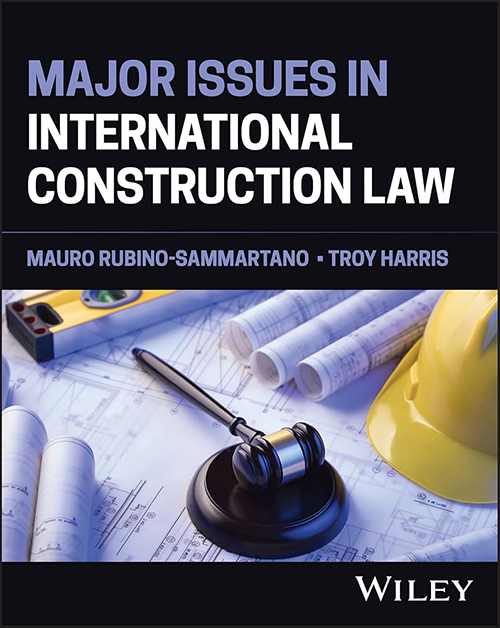
Major Issues in International Construction Law (2nd edn)
Editors: Mauro Rubino-Sammartano and Troy Harris
Contributors: Mauro Rubino-Sammartano, Paolo Daino, Giovanni Minuto, Virginie Colaiuta, Costanza Mosca, Marco Padovan, Michele Bonomini, Fabiola Viccei, Shona Frame, Keith Robertson, Jennifer Varley, Jeremy Glover, Giuseppe Giancarlo Franco, Lauren Davies, Nonkululeko Zondo, Basil Thévignot, Geoff White, Amy Lacey, Scott Chalmers, Aarta Alkarimi, Thiago Fernandes Moreira, Aline Piteres Porto, Vitor Parreiras Almeida, Maude Lebois, Nicolas Pralica, Garrett J Brown, Laura West, Julien Fouret, Camille Dupuy, Joy Harb, Nicholas Lingard, Rohit Bhat, Yoonji Lee, Alexandra Michalopoulou, Eleni Tsakri, Marlena Harutyunyan, Réka Àgnes Papp, Roberto Hernández-Garcia, R Bruce Reynolds, Nicholas Reynolds, Kathryn Irwin, R Zachary Torres-Fowler, Albert Bates, Jamey B Collidge
Published by: Wiley
ISBN: 9781394279159
627 pages, US$115 (hardcover), US$108 (e-book)
Publication date: 10 December 2025
Reviewed by Eric Franco
Mauro Rubino-Sammartano and Troy Harris have gathered an impressive group of construction law experts to offer a comprehensive, practitioner-led analysis of the project lifecycle, moving methodically from the embryonic stages of design and procurement through to the finality of dispute resolution.
One of the most compelling strengths of this volume is its editorial philosophy. By assembling a global roster of contributors, the text avoids the ‘jurisdictional parochialism’ that often plagues legal treatises. The contributors bring experience from both common law and civil law traditions, reflecting the reality of modern mega-projects where a London-based law firm might represent a Chinese state-owned enterprise building infrastructure in South America.
The book is structured to follow the project’s chronological development. Early chapters provide a rigorous examination of project delivery methods. While many texts focus heavily on traditional design-bid-build models, this volume gives significant weight to public–private partnerships (PPPs), alliancing and turnkey contracts. This is particularly valuable given the rising popularity of collaborative contracting models that seek to move away from the adversarial ‘claims culture’ that has historically defined the industry.
The sections dedicated to payment security and contract parties are perhaps the most practical for the day-to-day practitioner. The editors delve into the nuances of payment structures – lump sum, cost-plus and unit pricing – while providing a vital deep dive into statutory holdbacks and liens. In an era where insolvency remains a constant threat in the supply chain, the focus on payment security and the roles of guarantors and banks is both timely and essential.
Furthermore, the book’s treatment of insurance is a standout feature. By addressing builder’s risk and general liability alongside the often-overlooked political risk, the authors acknowledge the external pressures that can derail a project regardless of engineering quality.
Perhaps the most significant contribution this book makes to the field is its emphasis on claim prevention. Rather than focusing solely on how to win an arbitration, the text advocates for ‘paths to the prevention of claims’. The discussion on NEC-style early warnings, risk registers and design professional determinations reflects a modern shift in construction law toward proactive project management. It highlights that the most successful legal strategy is often the one that keeps the project out of the courtroom or the arbitral tribunal.
Major Issues in International Construction Law is more than just a collection of essays; it is a roadmap for the modern construction practitioner. Its succinct, practice-oriented summaries and ‘key takeaways’ at the start of each chapter make it accessible for busy professionals who need quick, reliable answers.